Agent factory · Run
Hand tickets to coding agents in isolated cloud sandboxes
Your team wants to hand tickets to coding agents, but not to a laptop with everyone's credentials and no record of what ran. hangar runs Claude Code, Codex, pi and Antigravity in isolated sandboxes, checks their work with your repo's own tests and hands back a draft pull request.
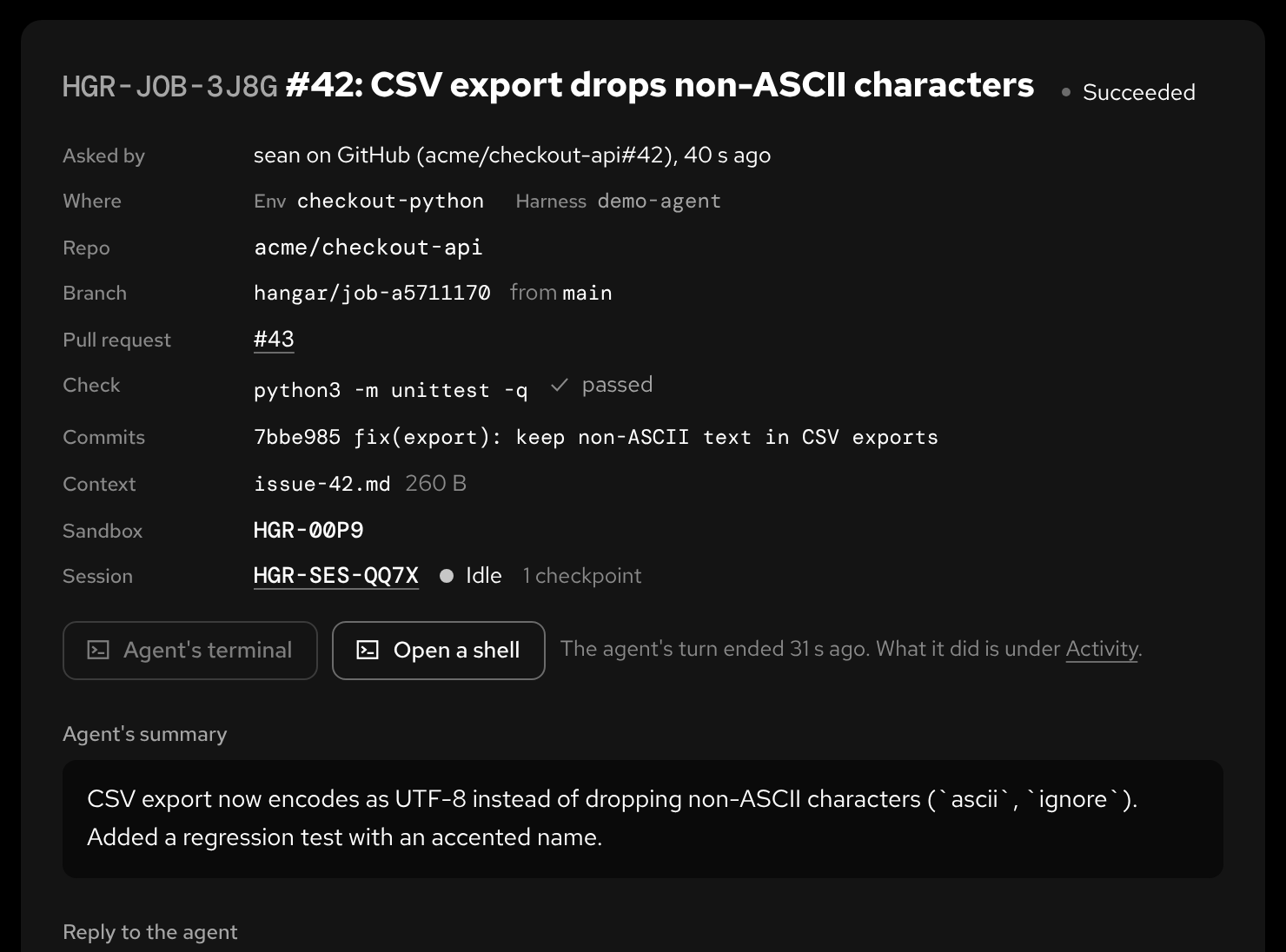
Who it is for
hangar. A sandbox starts from the repo's environment, the agent fixes it, hangar runs the repo's check and opens a draft PR that closes the issue. You review a PR, not a chat log.
Delegate from your agentDevelopers in Claude Code or CodexSay "hand this to the cloud". Your uncommitted changes go along, three attempts run in parallel, you pick the best and pull its patch back while your laptop stays free.
One fleet for the teamPlatform engineersRun one hangar on GKE. Everyone connects their own client with their own token; credentials stay behind a gateway, budgets cap spend, and the inbox brings each person their reviews, approvals and agents' questions.
New here? Read these five
- Concepts: environment, harness, sandbox, session and job.
- Quickstart:
hangar upon a laptop, then a first task. - The web console: Needs you, Jobs, Sessions and the Fleet.
- Jobs: hand work to an agent from a script, a ticket or Slack.
- The security model: what a sandbox can and cannot reach.
How it works
Many doors bring work in; hangar runs it in a sandbox and verifies it; the pull request is the one gate out. Around it, the team harness repo defines what the agents run, flightdeck judges the runs and Tower decides risky actions once an admin turns governance on. The suite's architecture page shows how they connect.
What it looks like
The console on :8787 opens on Needs you: held tool calls, jobs waiting to start and the agents' questions, decided in place. The web console walks through it, the Jobs and Sessions pages and the Fleet.
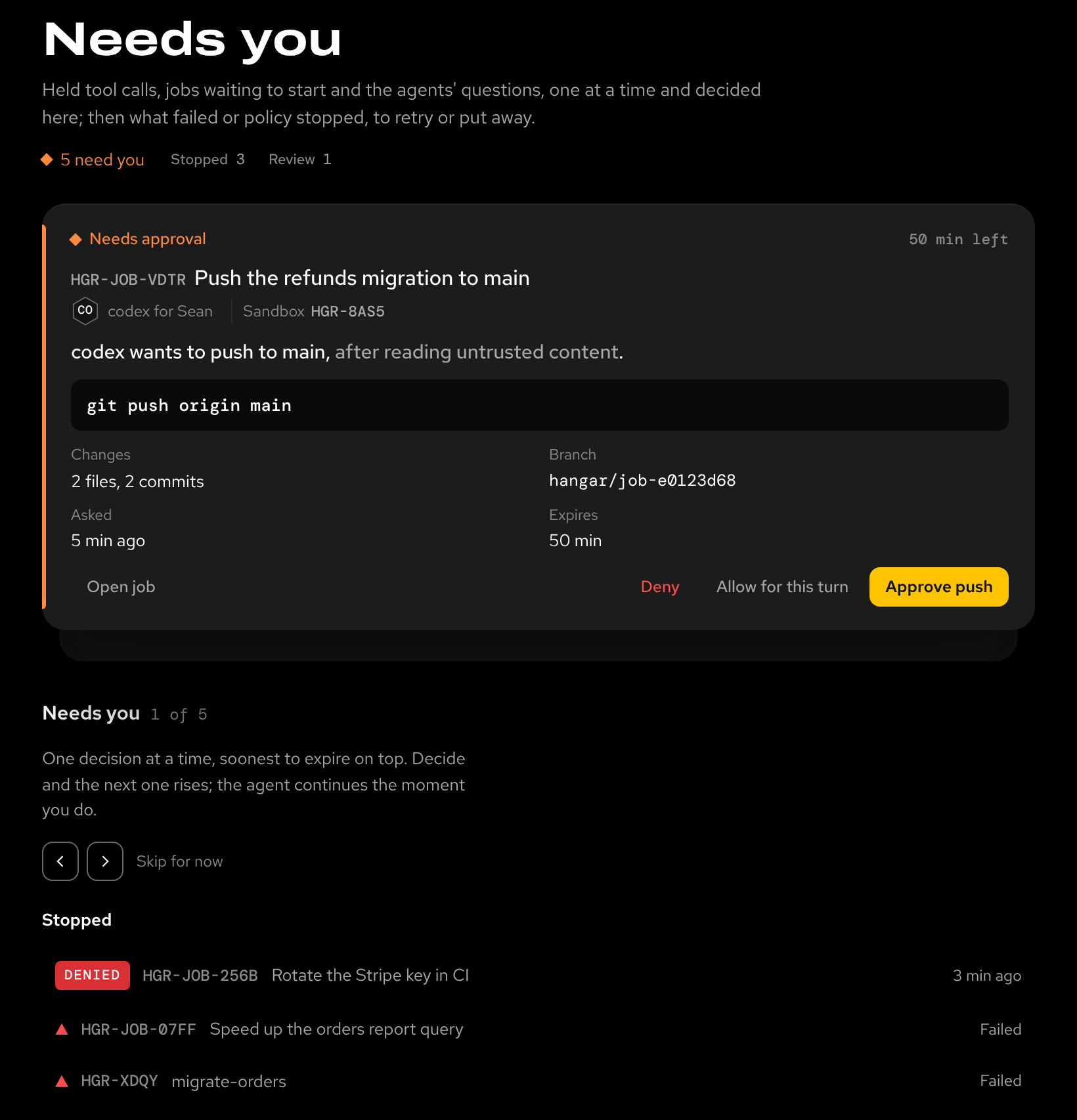
git push on top, with Deny and Approve push; the next decisions and what stopped beside it.Features
| Feature | What it gives your team | Status |
|---|---|---|
| Many front doors | MCP clients, the CLI, REST, GitHub issues, Jira, Slack, webhooks and schedules all become jobs or sessions, with one repo policy for each repo. | Shipped |
| Isolated sandboxes | Each has its own files, tools, checkout and agent configuration, from environments you prepare once; fork a prepared one into parallel attempts. Docker, gVisor or Kata, GKE or E2B. | Shipped |
| Any agent | Claude Code, Codex, pi and Antigravity as harnesses, pinned by version; a Codex client can ask for Claude Code and the other way round. A team shares one harness (instructions, skills, Claude Code plugins) frozen from a good run into a harness repo. | Shipped |
| Verified delivery | The repo's own check runs before anything is pushed; hangar pushes through the git gateway and opens a draft PR with a review packet; with landing, an approval lands it. | Shipped |
| People in the loop | Steer a running agent, answer its questions where it asked (the ticket, the Slack thread, MCP), watch its terminal; the inbox and the web console show what needs you. | Shipped |
| Resumable sessions | The conversation and repo state survive the sandbox; come back days later or fork a session. | Shipped |
| Hostile-sandbox security | Credentials stay behind a gateway; intake jobs get an egress allowlist and no push rights; tainted work opens as a draft and needs a second person. See the security model. | Shipped |
| Usage and insight | Tokens, cost and budgets per job and person (activity), traces as OTLP (observability), and run capture for flightdeck. | Shipped |
| Shadow runs | A repo policy samples real tickets and runs a candidate harness on each at the same base commit; it delivers nothing, and flightdeck grades it against what people merged (shadows). | Shadow |
| Governed approvals | Job release, landing and risky tool calls ask Tower, the Govern plane, which decides and signs a receipt; hangar enforces and fails closed. On GKE it runs in shadow: hangar's rules decide and Tower answers a dry run. An admin sets a kind to enforce to let Tower decide (Tower beside hangar). |
Shadow |
| Overnight lane | One Spot node kept up while the sandbox pools are powered down (01:00–10:00) for the intake jobs of repos that opt in and for evals, so evening tickets become PRs by morning; off until an admin turns it on (the overnight lane). | Shipped |
| Plugins and events out | Doors, trackers, notifiers and deliverers are plugins: a package of your own adds a chat bot's door or a company tracker without changing hangar, and every job change goes out as a signed hangar.event/v1 (plugins). |
Shipped |
| Deploy on your company's cluster | Kustomize base and components, a Terraform module that never creates a cluster, released images, secrets from your secret manager and admin configuration as reviewed files (hangar apply) (company deploy). |
Shipped |
| Bots that act for people | A chat bot's relay token submits work as the linked person who asked, with their rights and audit trail, never more (relay). | Shipped |
Shipped: on main, on by default or behind a setting. Shadow: built, and runs beside real work without changing what people get. Partial: built and tested; its wiring is in progress. Planned: next on the roadmap.
Security posture. hangar treats every sandbox as hostile. A job from an intake door (a GitHub issue, Jira, Slack, an inbound webhook) can fetch its repo but never push: hangar pushes the commit it verified, through the git gateway. Its network is an egress allowlist, the agent has no sudo, and automated work never uses a subscription login. Once an agent has read untrusted content, its PR opens as a draft and a second person, not the requester, must approve it to land. See the security model and the safe-release upgrade.
Where to go next
hangar up, a credential, a first task, your own environment, then GKE and a team.
The wordsConceptsEnvironment, harness, sandbox, session and job, and what hangar gives you that a laptop does not.
The screensThe web consoleNeeds you, Jobs, Sessions, the Fleet, terminals, and what each action does.